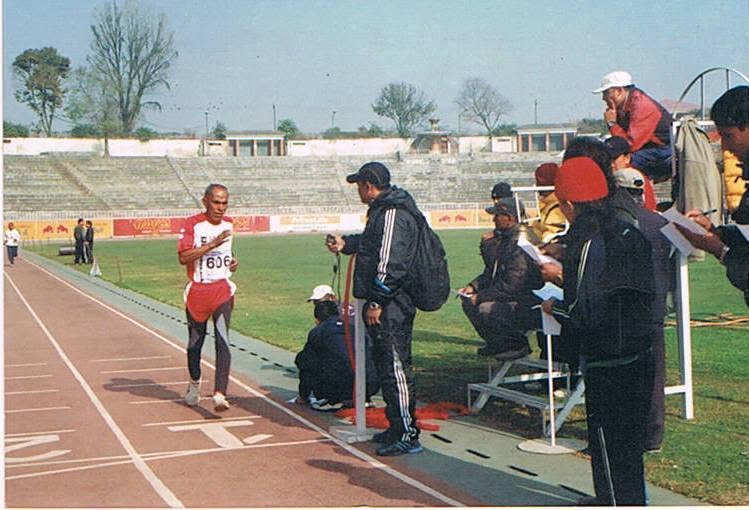
4 October, Kathmandu. Gave international recognition to the country by running, won three consecutive gold medals in the South Asian Games. Represented Nepal in four Olympics. And made a record that will continue to challenge Nepali athletics for decades. He is Baikunth Manandhar.
Even at the ripe old age of 75, he is often found at the track and field of Dashrath Rangshala. His love for the game has not diminished yet. He runs to the stadium two days a week, watches the players and is interested in the state of Nepali athletics. Manandhar, who once made Nepal's name shine in international athletics, has not been able to stay away from sports even now.
The record of 2 hours 15 minutes 3 seconds set in 1987 is associated with Manandhar's name, which is considered synonymous with Nepali Marathon.
He made history by winning three consecutive gold medals in the South Asian Games (SAG) and this record is still standing even after nearly four decades. This record is not only broken by Nepal, but also by players from South Asian countries.
He is more worried than proud that the record in his name has not yet been broken. He wants a Nepali runner to beat that time and Nepali athletics to reach new heights.
"It's been a long time since I made a record, I want my record to be broken, every year new players make records," says Manandhar, "but it's sad that we have to be proud of such an old record."
He is not limited to that. He is the first Nepalese athlete to win three gold medals in a row and is also a runner who has represented Nepal in four different Olympics. To some extent, he did not play in the 1992 Olympics even though he was selected to give a chance to new players.
"I have played four times, now I am the only one playing. When will the new boys get a chance?" That's why I didn't play," he remembers.
Manandhar maintained his dominance for about 20 years. He set a record of 2 hours 15 minutes 3 seconds in the 3rd South Asian Games (SAF) held in Kolkata, India in 1987. Which has not been broken yet.
Similarly, he won consecutive gold medals in the Saag held in Kathmandu in 1983, the Saag in Bangladesh in 1985 and the Saag in India in 1987. He is also the player who won the first gold medal for Nepal in Saag.
He also participated in the Olympics of 1976, 1980, 1984 and 1988. Even though he was selected, he did not play in the 1992 Olympics because he wanted to give opportunities to new players.
Even now, Manandhar wants the new generation to surpass his achievements. However, he believes that if the record is not broken, it is not enough to question the ability of the players. Manandhar believes that the training system, nutrition, facilities and long-term plans for preparing players should also be reviewed.
The experience of senior players was not used
Even though the stadium cannot come regularly like before, the condition of sports and the problems faced by the players continue to worry Manandhar. "It is not enough to show the lack of effort in the players, we should also question what kind of environment the state and sports bodies have prepared for them to succeed," he says.
Manandhar feels that the experience of veteran players like him is not being used in the current sport. "New leadership comes in sports, there are new plans and programs, but the relevant bodies do not show enough interest in getting the experience of players who have competed at the international level for years," he complained, "You can take advice from people like us!" You can call and ask for experience, but we don't have anyone to consult with us.
In the 20th Asian Games held last October, Nepal was limited to two bronze medals. Manandhar is not satisfied with Nepal's performance. Although he acknowledges the hard work of the athletes who won the medal, he says that it should not be seen only as a success of the overall preparation.
"Let's not say that they got those two medals by luck, they will know how it happened and that is also the hard work of the players," he says.
Manandhar's experience is that it is not practical to expect results without preparing the necessary players, training and infrastructure. "It is not wrong to aim to win a medal within four years, but it is not practical to expect a medal without preparing the necessary players, coaches, training and infrastructure to achieve that goal," he says.
Usually in Nepali sports, there is a provision for training as the competition approaches. Which Manandhar did not like. He says that the tendency to start preparing for another tournament only after the completion of one tournament will not promote Nepali sports in the long term.
"It takes 10 years to prepare players, now we have to start training 12-13-year-old players, after gradually preparing them, more players will come," he says, "After one international tournament is over, we should not start preparing for another tournament."
Manandhar emphasizes that the work of preparing players should be carried out in a planned manner from an early age. "What kind of potential is there in which sport, from what age to start training, what kind of coach is needed and to what level the players should be brought up," he says.
Manandhar gives equal importance to nutrition management along with training in Nepali sports. According to him, food should be arranged according to the physical structure of the players, the nature of the game and the intensity of training.
"A weightlifter and a marathon runner should not be given the same food," he says.
A review of the overall sports system is needed
Jit Bahadur KC is considered as a living history of Nepali sports. Jit Bahadur won a medal in the marathon of the first Asian Track and Field Championship held in Manila, Philippines in 1973 and gave Nepal its first international medal. He managed a competitive time in the marathon amid limited facilities and poor training arrangements. Remembering Jit Bahadur, Manandhar argues that if the new generation is unable to improve the achievements, the overall system should be reviewed along with the efforts of the players.
Manandhar did not have enough facilities in his sports life, but at that time players used to practice based on the experience and suggestions of seniors. His experience is that even though technology and scientific knowledge are available in sports, they have not been used effectively on the field.
It is Manandhar's experience that although it is expected that the old weaknesses will be improved after the new leadership, there is no concrete plan for the players. "If there is a change in the leadership in various bodies of sports, the system will not improve," he says, "regular competitions, systematic training, skilled coaches and a policy to secure the future are necessary for the players."
Manandhar seems worried when he sees the players fleeing recently. He says that there is a need to create an environment where players can continue their playing life and lead a dignified life.
"It is not the state's responsibility to make the players participate in the competition, they should be given regular training, necessary nutrition, competitive opportunities and confidence in the future," he says.
Manandhar insists on the need to increase investment by identifying potential sports taking into account the geographical structure of Nepal.