There are probably few people who have not heard and heard the lapchi of Dolakha. From a religious, cultural and geographical point of view, Lapchi is a very beautiful place, where no matter how many times you visit, you will never get bored. I also place Lapchi as one of the places I would like to visit again and again. There are many people who come here again and again.
However, Lapchi is not just a place to enjoy and visit, it is an important center of world peace, meditation and sadhana. As soon as they think of going for a trip, many people think of activities like having fun, dancing, drinking alcohol and eating meat and fish. However, it is not appropriate to understand the Lapchi located in Bigu rural municipality-1 Lamabagar of Dolakha only in this way. It is necessary to understand its religious, cultural and spiritual significance.
Lapchi is a holy place of pilgrimage for Buddhists. Milarepa, a great yogi and seeker of the Tibetan Buddhist tradition, is believed to have meditated and meditated in various caves in this region. Therefore, the caves, monasteries and natural structures here carry historical significance along with religious beliefs. The introduction of Lapchi is not only limited to the beautiful scenery of the Himalayas, it is also a unique land of peace and meditation.
This time we had planned to go to Manjushree Pond via Lapchi. Despite repeated attempts, the opportunity to visit Manjushree Pond did not materialize. This time, he was determined to leave even if he had to face snow, wind and rain.
Vinod Tamang, Vasu Thapa, Krishna Thakuri, Dipesh Ghising, RUS and I stayed at Choraghefilling monastery. The next morning we prepared to leave for the trip. Laxman Tamang also came to show us the way. He encouraged us to travel by saying 'Now walk quickly'.
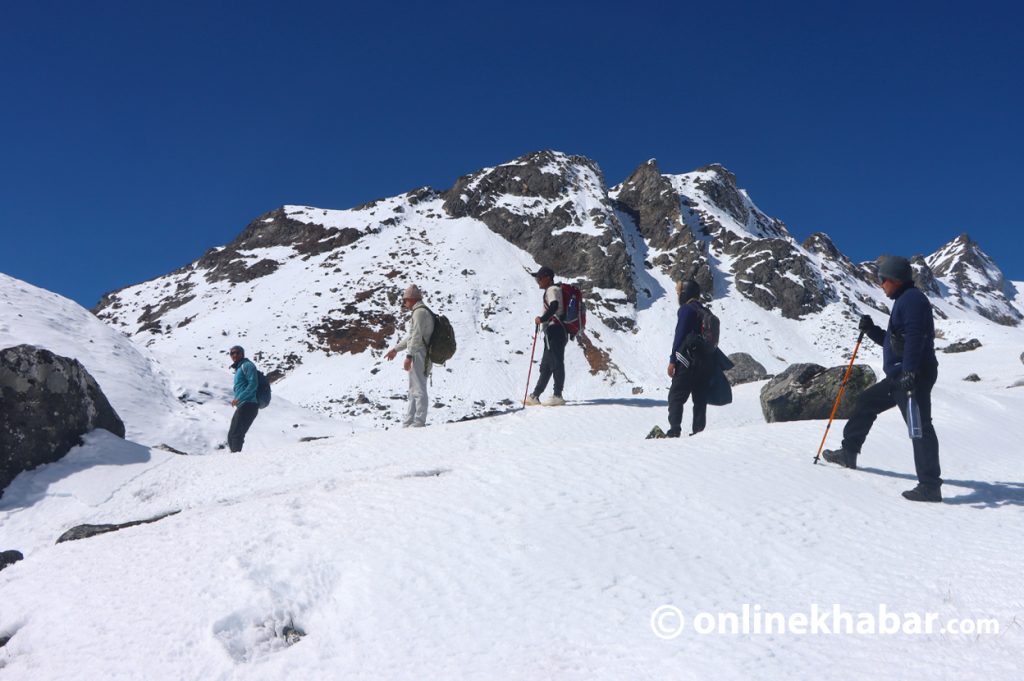
After about an hour of walking on a horizontal path from the monastery, the ascent began. After that, we had to cross a continuous uphill and snowy road for seven hours. The altitude, snow and cold weather were making the journey challenging. But surprise! I did not feel hungry, thirsty, or tired during the snow trip. Taking photos and videos at places, I felt that the road was short. The nearby snow ranges, small and big ponds and snow-covered mountains were making the journey even more exciting. After seeing such a unique view of nature, I felt a distinct joy in my heart. Sometimes it seemed like heaven was found on earth.
Manjushree Pond! How sweet the name is. I was already familiar with Manjushree's name and story. I have heard many times the story of Manjushree, which is connected with the origin of Kathmandu Valley. As mentioned in the Buddhist scriptures and Swayambhu Purana, Kathmandu Valley was once in the form of a huge lake. Swayambhu Jyotirup appeared on a lotus flower in the middle of the lake. There is a religious legend that Bodhisattva Manjushree, who came from China to see it, used his sword of wisdom (Chandrahas) to cut the hill of Chovar and send the water out of the lake. After that, it is believed that human settlement in the valley became habitable land.
There is a religious belief that settlements developed in Kathmandu valley only after Manjushree drained the water. But there is no proven fact as to which historical year or date this event took place. This is a legend that has been heard for generations in the Buddhist religious tradition. Geological studies also support the fact that the Kathmandu Valley was once a large lake and the water was drained from the Chobhar area. This has made Manjushree's story more interesting. Manjushree's relationship is not limited to Kathmandu Valley. Manjushree has a separate religious place in Swayambhunath area. He is worshiped as a Bodhisattva of knowledge, wisdom and wisdom in the Buddhist tradition. In Hindu tradition, Manjushree is also associated with Saraswati. Bhimeshwar Municipality-2 of Dolakha also has a statue of Manjushree and Manjusree Park built in his name.
Such religious and cultural stories increased my interest towards Manjushree. Perhaps this is the reason why Manjushree Pond was attracting me again and again. No matter how difficult the journey was, the name of Manjushree and the stories associated with him did not let my enthusiasm weaken. During the journey, for the first time, a small and stagnant pond was seen. The lake at an altitude of about 4,800 meters is also known as Manjushree Lake. The pond, which looks small from a distance, seemed to be very big when we approached it. This pond is located in Dolakha district.
After traveling for about one and a half to two hours from there, we finally got an opportunity to visit another Manjushree pond. Located at an altitude of about 5 thousand 16 meters, this pond is located near the border with China. Looking at the local roads and geography, it is possible to reach there through the terrain towards Nepal. Due to the mountains and difficult geographical structure on the border with China, the locals have been using the road from Nepal. Finally, after a long wait, when Manjushree reached the shore of the pond, his happiness knew no bounds. It was as if my feet were not on the ground in happiness. I visited the pond. touch the water I sincerely asked for blessings and told my wishes. When I reached there, I really felt that I had arrived at a holy religious and spiritual place.
A closer look at the pond looked very large. The higher I climbed and looked from above, the bigger it looked. Surrounded by mountains, snow and natural beauty, the view of the lake is difficult to describe in words. After reaching there, he kept silent for some time, but many thoughts kept playing in his mind. It made me think about the relationship between the vastness of nature and human existence.
This area falls within the Gauri Shankar Conservation Area project. There is a lot of potential to develop this place with religious, natural and geographical importance as an important religious and tourist destination of Nepal. But while developing such places, it is equally necessary to preserve its originality and religious purity. It is not enough to promote Lapchi and Manjushree ponds as ordinary tourist destinations. You should also be able to understand the religious beliefs, Buddhist culture, meditation and sadhana traditions here.
Tourism is not only entertainment. Some trips are made to understand oneself, to become familiar with history and culture and to get closer to nature. This trip to Manjushree Pond was like that for me. The religious importance of Lapchi, the legend associated with Manjushree and the unique beauty of the pond located in the lap of the mountains made me want to visit that place again. Maybe that's why, there are some places, where even after reaching, you don't want to go back. Lapchi and Manjushree Pond have become such places that remain in my heart.
Jeevan Lama is a journalist working in Dolakha.
TU INTERNATIONAL CRICKET STADIUM
Lumbini Lions won by 4 wickets