29 October, Kathmandu. The long-standing geopolitical and diplomatic dispute between India and China over the border area of Ladakh has flared up again.
After the Indian government announced the official and standard names of 28 geographical places in the Union Territory of Ladakh, China has objected to it. China has made it clear that it has never recognized the so-called Union Territory of Ladakh, calling India's move illegal and invalid.
On the other hand, India completely rejected this claim of China and reiterated its position that Ladakh is an integral part of India and this established fact cannot be changed despite Chinese objections.
This latest dispute over maps and naming between the two neighboring countries has created a new wave in bilateral relations that have been trying to improve since the 2020 military clash.
In the immediate background of the dispute is the latest move by the Ministry of Home Affairs and the Survey of India, Government of India.
The Ministry of Home Affairs of the Government of India made the official announcement on October 2 after consultation with the Ladakh administration and local stakeholders. According to the declaration, the names of 28 important geographical places within the Union Territory of Ladakh were registered and identified as standard names on the official survey map of India.
According to the Ministry of Home Affairs, there are 10 peaks, 3 mountains, 7 terrains, 2 gorges (passes), 2 glaciers, a valley, a river, a lake and another reservoir (water body) in these 28 geographical places. These named locations also include strategic sites such as Gogra and Hot Springs near the India-China border.
According to the Ministry of Home Affairs and Ministry of External Affairs of India, the main objective of this exercise is to ensure the correct identification of these geographical places and to increase clear awareness about it among the general public and agencies. However, within a few days of India's announcement, China strongly objected to it.
China's objection and the statement of the Chinese Foreign Ministry
During a regular press conference held on Tuesday, October 13, Chinese Foreign Ministry Spokesperson Mao Ning expressed strong displeasure with India's naming decision. Responding to media inquiries, spokeswoman Ning asserted that the western part of the border is China's sovereign territory.
Chinese Foreign Ministry spokesperson Mao Ning released an official statement saying, "China has never recognized the so-called Union Territory of Ladakh unilaterally and illegally established by India and strongly opposes the so-called standard names announced by India."
The Chinese spokesperson went further and said India's move was without legal basis. Mao Ning added, "India's move is illegal and invalid, and it cannot change the objective fact that the western region of the Sino-Indian border has always belonged to China."
China has interpreted India's naming process as an encroachment on its territorial claims, arguing that India cannot change the status quo of the border dispute by unilateral mapping or renaming.
Within a few hours of China's response, India's Ministry of External Affairs responded in strong terms, completely rejecting the Chinese claim. The official spokesperson of the Ministry of External Affairs, Randhir Jaiswal, while answering questions from the media, made it clear that there could be no compromise on the sovereignty of Ladakh.
Randhir Jaiswal, the spokesperson of the Indian Ministry of External Affairs, clearly said, "It is reiterated that the Union Territory of Ladakh is an integral and indivisible part of India. No matter how much the Chinese side denies, this established fact cannot be changed.
Citing the press release of the Ministry of Home Affairs, spokesperson Jaiswal further said, 'As far as the press release of the Ministry of Home Affairs of the Government of India is concerned, it is self-evident. In the announcement, it is mentioned that 28 places/features in the Union Territory of Ladakh have been identified with standard names on the official map of the Survey Department in consultation with the Ladakh administration and local stakeholders.
India maintains that since Ladakh is its internal territory, it has full right to correct the name on its administrative map or assign a standard name.
Repeated 'tit-for-tat' strategy
This dispute between India and China over official maps and naming of geographical places is not new. For the last few years, both countries have been adopting a 'tit-for-tat' strategy to strengthen their territorial claims through maps.
The dispute mainly started in 2017, when China began renaming various places in India's northeastern state of Arunachal Pradesh to Chinese. China has been considering Arunachal Pradesh as 'South Tibet'.
It has been issuing Chinese names on its official maps according to the rules of the Chinese Cabinet.
China has released a list of Chinese names for places in Arunachal Pradesh in six phases since 2017. Its sixth phase was released in April 2026, which included 23 locations. The list released in April 2024 was the fifth phase. China has also been doing controversial things like giving 'staple visa' to Indian citizens of Arunachal Pradesh instead of ordinary visa.
India has consistently dismissed these actions by China as imaginary or fabricated. Arunachal Pradesh is an inseparable part of India and India has started to respond in the style of China.
Last August only, the Government of India released the standard names of 27 geographical places of Arunachal Pradesh. Even then, China protested. After the move in August, on October 2, India responded to China in the same way by naming 28 places in Ladakh.
Since 2017, China has released a list of Chinese names of places in Arunachal Pradesh six times. India has also responded by issuing standard names in Arunachal and Ladakh.
China against Ladakh administrative reorganization
The background of China's recent outrage over the naming of Ladakh is linked to the Indian administrative decision of 2019. On 5 August 2019, the Government of India abrogated Article 370 of the Constitution and ended the special constitutional status of the then state of Jammu and Kashmir.
The next day, on August 6, India announced the division of Jammu and Kashmir into two separate Union Territories of Jammu and Kashmir and Ladakh.
China has been strongly objecting to this decision of India since the beginning. On August 6, 2019, Hua Chunying, the then spokeswoman of the Chinese Ministry of Foreign Affairs, reacted and protested against India's inclusion of the Chinese territory in the western region of the border into its administrative area and making Ladakh a separate union territory.
She called India's move "unacceptable". In response, India maintained that restructuring was an entirely internal matter.
When the two autonomous regions formally came into existence in October 2019, another Chinese spokesman, Geng Suwang, reiterated the objection.
Spokesperson Geng Suwang said, "India's move to make Jammu and Kashmir and Ladakh a so-called union territory has put some parts of Chinese territory under Indian administration." This step is illegal, null and void and cannot change the reality.
At that time, the then spokesperson of the Indian Ministry of Foreign Affairs gave a strong reply that since India does not comment on the internal affairs of other countries, other countries including China are not expected to comment on India's internal decisions.
Not only this, at the request of Pakistan, China also raised this issue in the closed-door meeting of the United Nations Security Council regarding the issue of Jammu-Kashmir and Ladakh in 2019. But the other permanent members of the United Nations Security Council, the US, France, Britain and Russia, showed no interest in the Chinese proposal. China could not get any support from there.
Later, in December 2023, after the Supreme Court of India ruled that the government's decision to abrogate Article 370 was constitutionally justified, China protested again. On 13 December 2023, spokeswoman Mao Ning stated that the court's ruling does not change the fact that the western part of the border has always belonged to China and that China will never recognize Ladakh as a Union Territory.
2020's Military Encounters and Diplomatic Upheavals
This border dispute between India and China is not limited to paper and maps only. It has even brought the two countries to the brink of war.
From June 15, 2020, there was a violent clash between the soldiers of India and China in areas including the Galwan Valley of eastern Ladakh.
Soldiers from both sides were killed in the clash, due to which political and diplomatic relations between the two countries reached their lowest point in history.
The two countries held dozens of talks at the military and diplomatic levels after long-term military tension on the eastern Ladakh border. India and China finally reached an agreement in October 2024 to withdraw troops from disputed points along the Line of Actual Control (LAC). After this agreement, the door was opened to normalize the strained relations between the two countries.
In order to improve relations, both countries started adopting various measures to increase trust. At the same time, there was an agreement to re-operate the stopped direct air services between the two countries. India has resumed the process of issuing tourist visas for Chinese nationals.
The Kailash Mansarovar Yatra, a sacred pilgrimage site for Hindus, was also re-launched.
The heads of both countries have held high-level meetings to promote the political dialogue between the two countries from the top level.
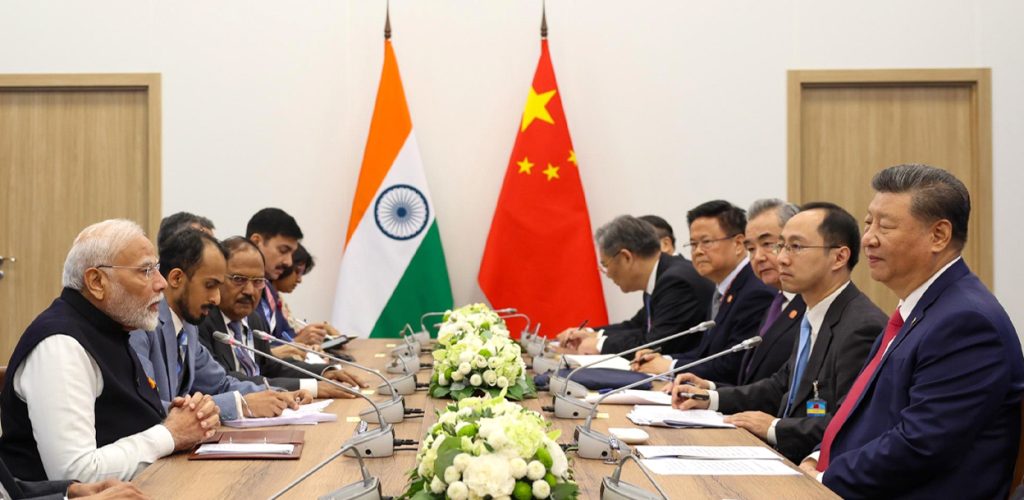
Indian Prime Minister Narendra Modi and Chinese President Xi Jinping held important bilateral talks during the 2024 BRICS Summit in Kazan, Russia. In that meeting, both the leaders directed their governments to start the process of normalization of bilateral relations by maintaining peace on the border.
Diplomatic exchanges then gained momentum. In 2025, Indian Prime Minister Narendra Modi visited the Chinese city of Tianjin to attend the Shanghai Cooperation Organization (SCO) Heads of State Summit.
Similarly, Chinese President Xi Jinping also came to India's capital, New Delhi, for the recently concluded BRICS summit. This was President Xi's first visit to India after a long gap of seven years.
During the summit, both Prime Minister Modi and President Xi acknowledged the steady progress in bilateral relations since their previous meeting. On that occasion, Indian Prime Minister Modi specially emphasized that maintaining peace and stability in the border region is a necessary prerequisite for the further development of the relationship between the two countries.
Ajit Doval and Wang Yi held the 24th round of Special Representative Talks in New Delhi on 19 August 2025 to find a solution to the border dispute, in which it was agreed to explore the 'early harvest' of demarcation in appropriate areas and to form an expert group under the India-China Border Affairs Consultative and Coordination Mechanism (WMCC).
This was followed by the 25th round of talks in Beijing on 25 August 2026, where eight points were agreed to progress towards an 'Early and Substantial Harvest' for demarcation and border management.
Kanchan reports on current affairs in Online News.