
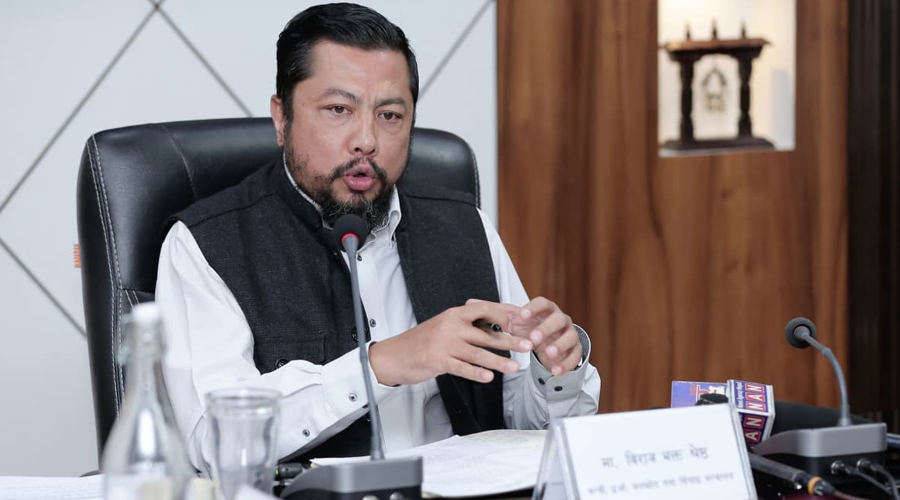
28 October, Kathmandu. Minister of Energy, Water Resources and Irrigation Virajbhakta Shrestha has announced the achievements in the field of energy, water resources and irrigation in 6 months after the formation of the government.
According to the details released by the Ministry, during this period, priority has been given to the expansion of irrigation facilities, construction of electricity transmission lines and substations, hydropower project permits, promotion of renewable energy and improvement of the flood warning system.
Since the formation of the government, 1 thousand 300 hectares of additional irrigation facilities have been extended through Sikta irrigation project, 1 thousand 155 hectares of Mahakali irrigation project, 600 hectares of Babai irrigation project, 610 hectares of Badkapath irrigation project and 150 hectares of agricultural land through Rani Jamra Kularia irrigation project.
It is mentioned in the details of the ministry that irrigation facilities have been extended to a total of 3,815 hectares of land through these five projects alone.
The government has also set a target to complete the projects of national pride in irrigation within a certain time. The Babai Irrigation Project and the Bheri Babai Diversion Multi-Purpose Project are targeted to be completed within the next two financial years. According to the Ministry, the Water Resources and Irrigation Department has been instructed to prepare an action plan to complete other national pride irrigation projects within the next five years.
From increasing power transmission capacity to moving stalled projects forward
According to public information, work has also been progressed in improving the electricity transmission and distribution system. Nepal Electricity Authority has completed the construction of 24 km section of Dhalkebar-Balganga 132 KV transmission line and put it into operation from last June 20.
Similarly, 20 km section of Lalbandi-Salimpur 132 KV transmission line, Salimpur substation has been completed, Bahrbise-Lapsiphedi 400 kV transmission line, Bahrbise and New Khimti 400 KV substations have been completed and partially put into operation.
Marsyangdi Corridor under 220 KV transmission line, Markichoke-Bharatpur section has been completed and put into operation. Construction of 132/11 KV substation at Kathmandu Chobhar has also been completed.
Construction of the Hetaunda-Dhalkebar section of Hetaunda-Dhalkebar-Inaruwa 400 kV transmission line, which has been blocked for a long time, has also progressed. The power system has been improved by constructing an Emergency Restoration System (ERS) tower in the damaged section of the Kohalpur-Surkhet 132 KV transmission line.
Agreement to increase electricity import-export capacity with India
According to the ministry, there was an agreement to expand the power import-export capacity between the two countries from the 13th meeting of the joint directorate committee at the energy secretary level between Nepal and India.
The meeting held in Pokhara on June 31 has agreed to increase the combined power transmission capacity from Dhalkebar-Muzaffarpur and Dhalkebar-Sitamarhi 400 KV transmission lines from 1,000 MW to 1,400 MW for import and from 1,100 MW to 1,650 MW for export.
Survey permission for 1623 MW project
The Electricity Development Department has issued survey permits to 23 hydropower projects with a capacity of 1,623 megawatts during the review period. Similarly, production permits have been issued to four projects with a capacity of 30.59 MW.
According to the department, 15 transmission line survey permits and seven new transmission permits have been issued. In the financial year 2082/83, 4 billion 323 million royalties have been collected, and up to the current year, more than 1453 million royalties have been collected.
Electricity Authority Restructuring and New Bill
The ministry said that it is preparing a restructuring roadmap to divide the Nepal Electricity Authority into three separate companies for production, transmission and distribution and trade.
As mentioned in the budget of the current year to complete the restructuring of the authority, the committee formed under the coordination of the head of the energy division of the ministry is working to finalize the roadmap after studying various international practices.
2.4 lakh SMS on flood warning
It has been announced that the agency under the ministry has also worked on improving the flood and disaster early warning system.
On August 10, after the flood caused by an avalanche from the Nepal-China border, the Hydrology and Water Resources Research Center has sent about 7 lakh SMS to the Bhotekoshi-Trishuli river coastal areas of Rasuwa, Nuwakot, Dhading and Chitwan. On August 11 and 12, another 700,000 SMSs were sent about the risk of another flood.
Similarly, from 8th to 12th October, about 1 million SMSes were sent through Nepal Telecom and Ncell about the risk of possible floods and landslides. Thus, it is seen from the details of the ministry that about 2.4 million SMS were sent for information related to these incidents.
6 months achievements public, implementation results yet to be seen
In the details released by the ministry, policy reform, project contract management, infrastructure under construction, issuance of permits, studies and service expansion have been included as achievements.
However, some of the works mentioned in the details have been completed, while some are in the stages of contract agreement, study, bid evaluation and policy preparation.
Therefore, when evaluating the achievements announced by the Ministry, it seems that the completed works and the plans to be implemented in the future should be looked at separately.
In particular, the goal of timely completion of irrigation projects of national pride, the restructuring of Nepal Electricity Authority, the speed of construction of transmission lines and the effectiveness of flood early warning system will measure the future performance of the ministry.


