1. I was just starting to read Romila Thapar's 'Just Being' (it will take three months to finish). His opening lines teased. Where is Thapa who has the image of a historian and where is Romila who is presenting extraordinary literary talent in the name of a memoir! She quotes Faiz Ahmed Faiz before starting the book. Faiz says:
Speak, even this little time is enough
Before death of body or speech
Speak, that the truth still lives
Tell me, JJ, tell me!!
Sir is angry on the forehead, if he calms down, I can only sleep. After living half of the sixth decade, even at the age of keeping everyone happy, I don't know why I get angry every now and then. I calm down after writing in anger and when something I said or wrote is made public, I feel sad - was it so easy to get angry? And while communicating with myself, I conclude that it is time to be so angry. Only those who write or speak know - it's easy to get addicted. It's easy to settle into a comfort zone. But it takes great courage to even get angry here.
I think it's time to speak up. At a time when the culture of speaking is being distorted and obscenities are spreading on the walls of social networks, when arguments are being strangled and some rabid conjectures are hurling around, it is important to speak as close to the truth as possible. Truth lives, lies cannot last long. Just as fake coins are found and destroyed and new coins are brought into circulation, in the same way those who are creating noise pollution in the world of thought should also be spoken out.
Today's era did not originate today. Today's society and people are not just products of today. It is part of an interactive continuum of human beings changing over thousands of years of history, new knowledge discovered, and various technologies discovered and used.
It is also a reproduction of the old and a person who is making himself new. Society was there yesterday, it will be there tomorrow. Neither today's technology and science, nor man and society exist outside the causal relationship of history. It is necessary to speak against the old times which are denying this.
It is necessary to speak in favor of those who are oppressed, oppressed by the society, who are suffocating as victims of life and world arrangements. People should also be told to dream that it is possible to move towards freedom and emancipation. I love the conclusion of Marx's quest. He says that the goal of his philosophy and struggle is to lead mankind "from the slavery of material needs" to liberation.
That is, when a person is not pressured to spend time and energy to get goods and services necessary for eating, living, dressing, reading or health treatment, only then is a person truly free. One is free to choose any profession, to do creative work, then a person is physically and culturally free (emancipated). In a capitalist system, such freedom is not possible, especially for the common man. At a time when the light of its realization is nowhere to be seen immediately, the institutions, structures and ideas of the state and the poisoned state of life must also speak to awaken the soul of the people.
I am inspired by the eloquence and willpower displayed by Neha Bora, an Indian girl speaking in Jantarmantar or any university auditorium. He takes help from him to confirm that he has to speak. At other times, it is books that inspire me to speak. They tease me about falling asleep or being depressed.
Recently three books came to tease me with some meaning. In the meantime, other things were also read, even discussed somewhere. I am currently reading - Mahendra Mahak's collection of stories 'Khudama' (Ah, a collection of powerful stories by this budding writer...).
Mitralal Pardhe's 'Yugantar' is a simple and sweet epic with a deep meaning. I am also reading Ganesh Prasad Lakh's 'Simanta Jakan'. Girish Giri's 'Veerganj', which is a bit old but has not been read completely. In the bag, after reading a few pages, Henri de Balzac's novel 'Kisan', written for Dasain expenses. You know the fun of reading, my friends!
Here, the memorable works - Arundhati Ray's 'Meri Maa Meri Gangster' and Vasant Thapa's 'Euta Uvsya Zindagi' and Purushottam Subedi's poetry collection 'Ujyaloko Prem Geet' will be visited. Even if it is from a book, it is to speak, to open the heart.
The most important thing is to say or write down what is on your mind. By saying or writing in tune with the rhythm of Dasain: let those who are sleeping be shaken, show resistance and do not let the oppressive forces fall asleep easily. Be on the side of those who are sweating, lost in corners, chased by debt, disease and hunger. Let justice be done. Let it be a song of freedom. (Until) let the speech be smooth, soft and luscious, but the meanings be shrill and shrill.
2. Making of Arundhati Raya
'Merry Maa Meri Gangster' or its original English form 'Mother Mary Comes to Me' is a wonderful gift given to us by Arundhati in recent times. Through this book, she has discussed in detail the social, economic, political, gender and cultural aspects that influenced her upbringing and her achievements. It is a memoir but it is like a novel, it is literature but it exposes political events and tendencies. Arundhati, who grew up in a Christian family with the rebuke and persecution of Mrs. Mary, a single woman with uncertain roof and soil, but educated and strong willed, has clearly reflected the changes that have come and gone in Indian society after 1980 in the book.
It tells the story of marginal life. It criminalizes politics and vilifies Hindus. The story is both family and exciting. To make us look back on our lives and ask, "Who did we live for? Did we live a meaningful life?" It forces you to ask questions.
"My work was different. My responsibility was to write. To write as a writer, not as a leader or an activist. To do that I didn't have to carry the burden of supporters or the pressure to live up to people's expectations. I wanted the right to be unpopular. I wanted the option to research, disagree, and stand alone within the bounds of consensus." (Rally for the Valley)
Arundhati recalled this phrase in reference to her long article 'The Greater Common Good', published in Outlook, about the Narmada Dam. In the background of which there are some disagreements with Medha Patkar. As a writer I envy her this power and assertion. A writer exploring alternatives to being unpopular, disagreeing and standing alone.
'Meri Maa Meri Gangster' is Arundhati's latest work. It is a memoir in the tradition of popular genre divisions, but it sheds the veil of personal experience and excavates many layers of contemporary conflicts in Indian society, delves into the burning issues of society. This in itself is the grand narrative of today's Indian society.
To read 'Meri Maa Meri Gangster' is to know Arundhati Rai and it is a parallel story of her mother too. But this is not just the story of two mothers and daughters. I am not going to discuss the inside pages of this book here. While reading the book, how did the Indian society prepare the opinion of Arundhati Rai, who is one of the world's first wave of public intellectuals today? In other words, 'Making of Arundhati Raya' becomes a subject of my interest and curiosity.
"Often I don't even understand how I'm living my life. I've given up trying. The truth is, ever since I met Sanjay and Pradeep, I've loved them both. In very different ways. We've hurt each other deeply, we've compromised.
We have each other's backs. We have supported each other, we have worked together. We are there for each other as brothers, parents, children, friends, whoever needs it, as well as support. We are people so intricately entangled in each other that no one can untangle us." (and the band broke up)
This is a part of his personal life. It is difficult to imagine this liberality in the relationship between men and women in the Indian society, which from this point of view is dominated by traditional traditional influences, mob lynching, honor killing, Ram Mandir and saffron-colored digdaggi and the dominant presence of sadhusants in politics, remittance politics, fierce repression of Dalits and Muslims and the brutal attack of power on Marxist or progressive ideology. It conveys the message that women are moving beyond certain barriers for freedom. This was a meaningful turn in the 'making' of Arundhati.
The story has parallel life stories of mother Mrs. Rai and daughter Arundhati. Reading the story, it seems that Mrs. Rai was a cruel and stubborn woman. Unable to bear the oppression of her father, Mrs. Rai left Mr. Vicky, an old man (nothing man) who was accepted from this first proposal, and went to make her own world with two minor children.
She is never seen showering her children with love and who arranged for her children's high school education, but always displayed cruelty to the extent of calling her daughter a 'ruddy' and kicking her out of the house. It was only after making a name for herself in Delhi that Arundhati met her father — Mr. Vicky Roy. Who was born to live under the influence of alcohol. Ama Rai, on her own, built a magnificent school in a Kaswa in Kerala, earned wealth and fame.
But daughter Arundhati never came to study architecture in Delhi after finishing her schooling and became a fukkafala, without parents, without love, she had to earn by herself. Shack camping, with men, marijuana and sex, music and reading. Film Screenplay, Acting respectively. Relationships and love with different men at one time. Careless distribution of self-earned royalties. Greedless psychology. Writing fame and exposing the growing hypocrisy within Indian democracy.
Sometimes with the Naxalite comrades of Dantewada, sometimes with the rebel youth of the neck of Kashmir, sometimes with the tribal farmers of the Narmada Bachau movement and sometimes joining the assembly halls and processions of Delhi, she made people's patriotism an integral part of her personality.
He stood against nuclear tests in Pokhran, anti-Muslim riots and massacres in Gujarat. And, gradually, Rai learned to stand up for justice on important issues such as global wars, imperialist intervention and colonial policies, climate change, and more.
Arundhati Raya's personality is shaped by her mother's stern behavior, pursuit of purity and boundless desire for freedom. Even though he was starving for many nights, despite obstacles and disappointments in the work he was doing, his integrity to fight tirelessly and never lose courage to find a way is tempting to see now.
His mother's role in shaping his personality is seen in the development of his political spirit, his search for freedom and love for marginal people and the influence of his studies and experience in broadening his knowledge. His associations and connections with progressive personalities have made him resistant.
I was an imperfect leftist
A very brief appearance with Arundhati took place in March 2000 in Delhi - at a conference. She was on stage as a speaker. It was a program organized by the Communist Parties and Socialists of India (I was forced to speak on the stage as a representative of CPN-Male by accident. We were invited by the Socialist leader Vijay Pratap).
Arundhati, who gave a brief statement, had become a global celebrity by then, not only because of her 'The God of Small Things' but also because of the powerful social issues she was effectively raising. Because of her power, she was now becoming the darling of the Indian establishment and her popularity was on the rise.
She has become an icon for those of us who have read her novel 'God of Small Things' and her essays and talks. The author, with twinkling eyes, curly short hair and a gravely observing face, has since given accounts of her jungle journeys with Maoist comrades, numerous essays and timeless works such as 'Ministry of Utmost Happiness'.
His power was based on anti-imperialism, anti-casteism, anti-Hindu politics, anti-environmental destruction spread by the RSS in classical language. And, he was in favor of the demands of the just struggle raised by the people of different levels and strata in India. In this broader ideological context, she was a leftist but not a communist. Communist parties invited him to the program because of his writings and discourses of people's support and his established personality.
But I cannot believe that she was an imperfect leftist as she says, rather she is an imperfect communist as she is sometimes called within the communist movement in India. Because he is not in any communist party. It has become a center of progressive power as an institution.
Although born in a Syrian Christian family, his first marriage to a Christian does not show his attachment to religion. Although she was in love and married to Hindus, she did not become a Hindu. Of course she was imperfect but it was her choice of freedom. Achieving such freedom for the common man is possible only by severing ties with structures made up of family, culture, religion and economic constraints, which few dare to do.
On the whole, it seems that the family environment and politics contributed negatively and his desire and commitment to freedom positively contributed to the formation of the intellectual power that Virlakoti people achieved. This narrative non-fiction of his is also a must read book.
3. A life made special from the average
"Mother seems to have sent me to enroll in school... I don't remember ever being present on such an occasion - one because of my profession and the other because of the politics he held. ... The reason why I wore a kattu instead of a half-sleeved shirt and pants was because Dharan didn't have hot weather. Even in winter, long-sleeved shirts and pants were not available, and that was because of the extreme poverty of our family." (My School of Barakhari)
This is a reference to 'An Average Life', a collection of memoir essays by Vasant Thapa, which reflects on his childhood. This past time of Dharan, sitting in the background of some of the golden days he spent due to his hard-earned privileges, keeps teasing him and haunting him with memory stings.
Vasantha is such a writer, who makes it difficult to tell whether his memoirs are personal feelings or portraits of the society at that time. His view is subtle, he studies the time spent by himself, the characters who are connected or not connected with him but who are connected with the surrounding environment, he respects history and builds character like a narrative. His childhood is spent by a laboring woman facing the hardships of a family cared for by many hardships. And, the contribution of his father Indra Bahadur Thapa, who is involved in politics, is seen in this. That is, an image of what a communist worker's family is like.
"The floor was covered with earth with a geiger on the ground covered by a circle of loose stones. The floor was poured with water to make it look like the floor of a house. It was left to be pounded, beaten and fixed. When the work of putting the roof was finished, the mother was in a hurry to move there. A chepua made of bamboo on four poles was tied to it and made like a room. And one evening, his tenant And the three of us moved there with a rag—my mother, my brother two years older than me. Even so, it was difficult to sleep on the floor of Bagrasman, even a temporary fence as high as a man gave me a feeling of security—of invisible ghosts, vampires, and visible snakes, scorpions, and jackals." (My Malgudi) The imprint of this experience of life in a young mind is often felt in the psychology of Vasant Thapa today.
Basant Thapa has the influence of his own father's rebellious spirit, morality, revolutionary dedication and sacrifice. He worked as a student leader of the then Rayamazhi group for a few years. But how can he reach Calcutta to ask for the hand of a young woman and his mother-in-law has agreed to give him a daughter on one condition: No more politics. He did not do politics after that. Being a neutral observer. And also, at the level of thought, they have a sense of responsibility towards society, in writing, in conversation and in lifestyle.
Poverty has given a class perspective to know the world since childhood, the literature, culture and reading culture available in Dharan has an influence. The multi-talented Thapa has Dharan's stamp on his outlook on life and also in his compositions. I have known him for at least 25 years. Even before that, I was familiar with his articles as the editor of 'Himal' magazine. When I came from Pokhara and trembled because I could not set foot here, her life seemed attractive to me.
Three years ago I gave a long dialogue for 'Nepal Readers'. For the past few years I have been trying to get to know him better as an avid reader of the memoirs he writes in the special issues that come out in Dasai. It is also known from these articles that there are many sad memories in these people who walk to organize cinema festivals with smiling faces, translators, editors, writers, leaders of organizations, former hotel owners, tourist guides, songwriters, etc.
His ability to sing songs from Hindi cinema at gatherings, with all the details of the composer, singer, music composer, director and actor of the song is infuriatingly attractive.
During the conversation, he said, "I am still an outsider to Kathmandu, I have not been able to take root here."
Even though he was born in Dandagaon of Dhankuta, the blood flowing in his veins is made from the climate of Dharan. But his writings say - how much of the hardship he suffered now?
Vasant is a wordsmith, his wordsmithing is indescribable. Vasant Thapa, who spent his childhood and adolescence struggling with life's many adversities, where he is today, the name he has, the work he has done and the place he has reached, is an achievement rarely achieved by anyone who grew up in his situation.
"Looking back, I see that those who embraced the politics of proletariat liberation at that time were mostly wealthy moneylenders and landlords. They had studied in Calcutta, Banaras, Allahabad and brought new political consciousness from there. Even those who did not receive higher education, there was no one who had a poor financial condition. All of them had rich land or some business in Madhes. Because of that, their life was comfortable and politics was their side business... Nunia used to cook basmati rice, but most of us had corn husks or rice husks. In other words, we were from the upper and middle class. (Difficult to live as a communist son)
He has expressed the sorrow of being a communist son, he presents some picture of the communist politics of Nepal and gives many lessons. As I am writing this, I have returned from my friend Vijay Paudel's funeral. He also grew up with the suffering of being a communist son. Later he vowed to set an example by doing some business himself and ventured into publishing and communication. But it was not possible to make a profit from the business that was chosen. He gave up. Modnath Prasrit, who was taken to Aryaghat for the funeral of his only son, was oblivious to Alzheimer's, and had no idea what was happening to him. Vijay lost and took leave. Spring has struggled and is upon us.
There were favorable conditions available in Dharan, using them and a little inspiration from his father's political colleagues Punyaprasad Acharya or Madanmani Dixit or BA Krishna and Madanmani Dixit gave Thapa a little basis to set the course for this long journey of life.
Each chapter of his memoir represents the society of his time. He exists as a medium and tells the story of society. His magical writing has the creative ability to show and hide himself at the same time. Anyone who wants to know how to write, what to write, how to connect their memoirs with society and how to tell their story without being overbearing should read this book. He has written the story of Dandagaon Dhankuta and Dharan with the ability to make the reader captivate by mixing the vast spectrum of feeling and reality, humor and sarcasm, emotion and imagination, society and economy and culture. From Kathmandu to foreign travel, from cinema to newspapers, from jail trips to politics, and especially about his family, the environment he grew up in, and the joys and sorrows he experienced.
He has created a good record of the time he spent by portraying the society's characters and tendencies in a subtle way and has enriched Nepali language and social studies.
If you are confused about how to know yourself, how to express yourself or you are looking for a way to become a writer, then read 'An Average Life' is a good recipe for you.
4. Purushottam Subedi singing love song of light
Poet and critic Purushottam Subedi is one of the 'dons' of the literary field. This is the undeclared leader or coordinator of Kavi Kuno, who has moved to a corner south of New Street Peopleboat. These are regularly present every Tuesday and Friday afternoon along with Bimal Nibha, Narayan Dhakal, Raghu Pant, Avinash Shrestha, Shardul Bhattarai and other random visitors.
They have become the bedrock of contemporary politics and informal debates that basically focus on literature and culture. Progressivism is his ideology. Through his creations, he continues to try to transform the society from the existing discriminatory net to a just society, from darkness to light. Retired Subedi's main genres are criticism, essays and poetry. Sometimes they also do translation work.
In his poetry, the fragrance of Nepalese society and soil comes. Common people are the area of concern of his poetry. He is an opponent of the capitalist world market, imperialism and despotism, and his creativity is to compose songs for the liberation of the common people.
In the story of Vokananga and the sad people
Sukumar Rajkumar is not a princess
Sponsorship is not fun
The facts are obvious
History of the Sacrifice of the Sixteen Martyrs
It had never happened before in this area
Resistance Squad of Sixteen Martyrs
Khoku is the soul of the land of Chintang
And that sacrificial staff is fire
This poem, included in the collection 'Ujyaloko Prem Geet', excavates the cruel oppression of King Birendra's government in the Khoku Chintang region in the year 2036. Appreciation of sacrifice and opposition to oppression, advocacy of justice is the essence of the poem. The brutal killing of Hankhima Saini, who was pregnant at the time of her killing, is a symbol of Panchayati Kalaratri and Purushottam respectfully escorts her to Mool Bahasam.
Subedi is saddened by the contrast between the dreams and actions of contemporary political characters and trends, especially left-wing political parties and leaders. They vow to rise again against the betrayal of time and start a new journey.
Let's start from the end.
Similarly, he hates the behavior of the leaders and the party. The poet expresses his anger on seeing how the same person or power yesterday was revolutionary, was in favor of the people and today he is betraying the times by wearing the shell of fake public favoritism. His works expose contradictions in the behavior of people's movements, people's wars and subsequent governments.
A person's face
In Behavior, Consciousness and Activism
Once visible
The status quo of naturalness and clarity
Just the opposite of a dual character
Corrupt, fake and unreliable
As the coils of a snake change
On the unchangeable character of man
Make no assumptions
His poem written on the subject of market-oriented level of social consciousness and consumerism is luring people by advertising the rush to become rich and happy and driving people away from believing in real knowledge, conscience, thought and continuous efforts to progress - 'Best Seller'. wrote:
They are sold in large numbers
A book about positive thinking
Listening to motivational discourses
Those who say good knowledge
'Prem Geet', composed of 58 prose poems originally composed of small rhymes and rhymes, really contains poems of love for people, soil and country. Purushottam paints a subtle picture of society and its trends, twists common usages, twists sentences and embellishes them like the ripples of thorn in a skillful garden. Hankhima sings the sagas of forgotten martyrs like Saili, and makes a mockery of Shakti-Pujaks who are completely fake after coming to power with a dream.
Ambiguous and chaotic
A storm of light?
He is a singer of light. Standing in opposition to the darkness and pointing fingers and singing in unison with the common people in welcoming the light is his poetic dharma.
Subedi is a powerful poet of his time. Poet Bimal Niva says about his poems, "Actually, poet Purushottam Subedi's poetry is built with a solid ideology. And that is the idea - a strong alliance with the just social aspect of poetry. That is, poet Subedi's poems are artistic vocabularies of conscious consciousness."
After reading Arundhati and Vasantha Thapa, I felt like I was writing my heart out in their writings, making the feelings articulate to others. They have lived through time, society, society issues, memories and struggles. It is difficult to separate how much of it is the writer's personal feelings and how much is the feeling of the society. On the other hand, Purushottam Subedi also writes from the heart, he has beautiful poems, thoughts, society and even his works are like engravings of scenes seen by observing and examining others. In the first volume, the poems in their own clay group are passionate portraits of self-realization. The rest are observer views and opinionated.
Although the writing, the art and the ideas are all excellent, the memoir feels like an x-ray of the person by taking off his outer cover. It's like looking at the human element inside a person or the skin that covers the depth of their feelings. Poetry has the eyes of an inspector and an examiner, which has assimilated society and trends. For the first time I experienced such a difference in memoir and poetry. Maybe you got a bias after reading and comparing?
Among these writers, Vasant Thapa is a person who has passed the age of 75 and has accumulated many experiences while struggling for life in the society of the 1960s. He is a left-wing activist of his time, a son of a communist, when communists believed in internationalism. Like, a group of Basantas were also going to Darjeeling to campaign for Indian Communists. But in his writing, he seems to be hiding something in terms of his thoughts, even though he says everything as neutrally as possible.
Purushottam is essentially a product of the 1970s in terms of ideas. He is influenced by Maoist Marxism. Marginal participants in politics there. He has come with a request for conceptual clarity in writing.
All these writers came from ordinary families. Subedi is economically comfortable but his political milieu has a society awakening against panchayat tyranny and the impression of revolutionary Marxism of Mao's cultural revolution which has had global influence.
Arundhati is the youngest of these. In his creations, the 1980s saw the waning of socialism and communist politics from around the world, especially from India, and the neoliberal economic policies implemented during the PV Narasimha Rao-Manmohan Singh era. LK Advani's Rath Yatra, the Babri Masjid incident, the subsequent riots and the awakening of saffron politics have had an impact on the times. It seems that after the failure of the Naxalwari movement, some sparks of frustration spread among the Indian youth had an effect on their formation. Reading his memoirs reminded me of Pankaj Bista's novel Lekin Darwaza.
Set aside a portion of this Dussehra holiday for books. Good luck!
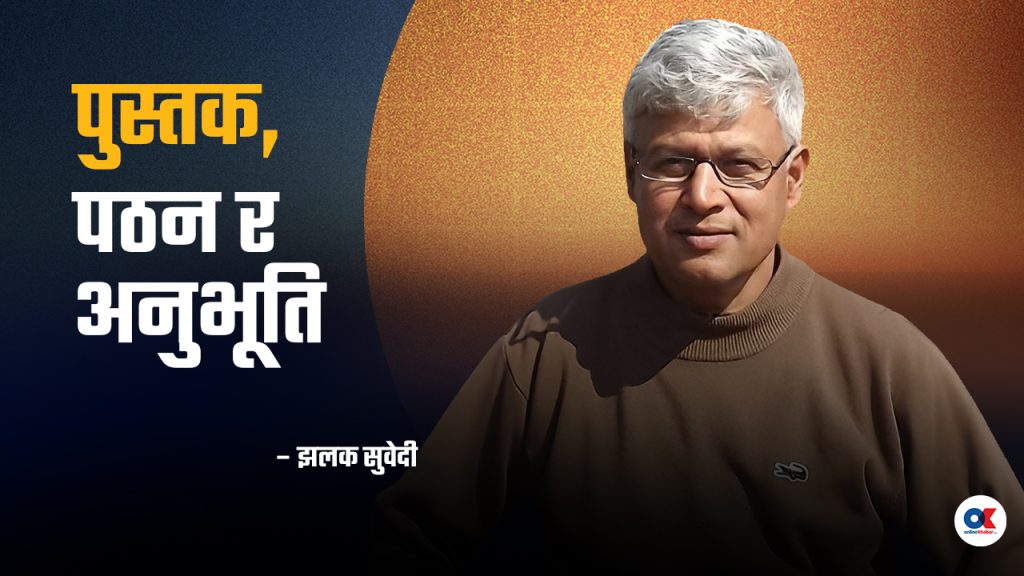
Jhalak Subedi is a political analyst.