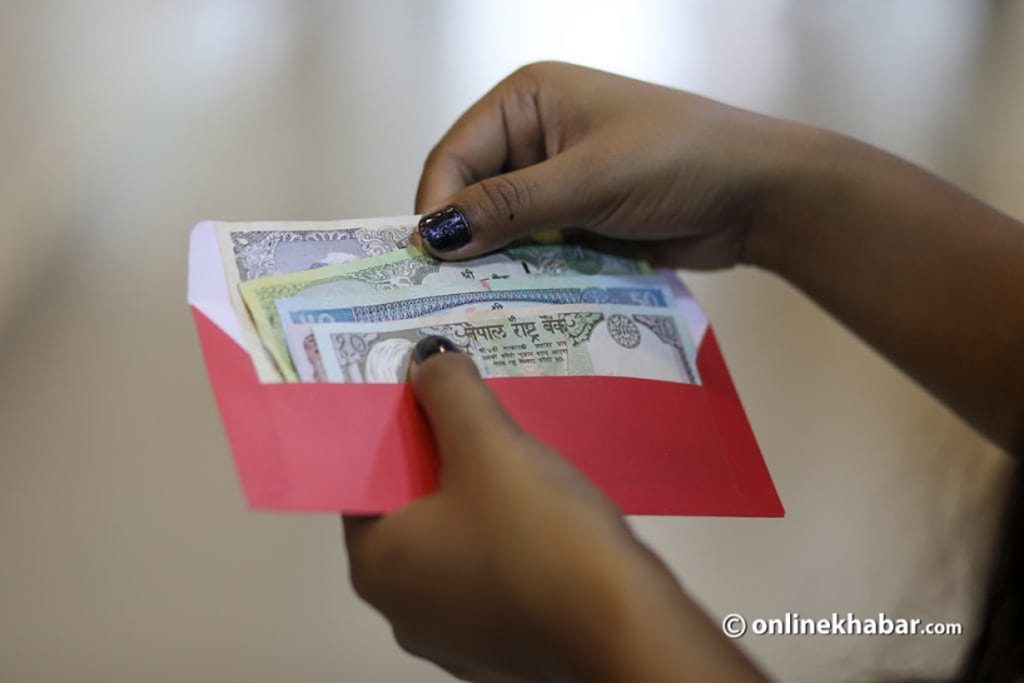
4 October, Kathmandu. You can develop the habit of investing from the Dakshina found in Dasain. If you are looking for an opportunity to make a big profit from Dakshina in the future by making investment seed capital, here are some options.
First Option: Mutual Fund
Even if you have only 1000 rupees, you can start investing by buying mutual fund units of that amount.
Investing today will create great wealth in the future. Hence, mutual funds are also suitable for developing investment habits. Mutual funds help to understand aspects like the return from investment, the increase in the value of that property.
It is easy for common people to invest in mutual funds. Even those who do not know much about the stock market can invest in it and get a lot of profit. Because, the financial experts, auditors, fundamental and technical experts in the mutual fund management plan make investment and transaction decisions.
According to Muktinath Capital's Chief Executive Officer (CEO) Kavindradhwaj Joshi, priority has been given to basic issues rather than technical ones during the analysis. Mutual funds also buy shares of some companies for trading purposes. "Funds allocated for short-term transactions are comparatively less," he said.
Investment can be started by buying at least 100 units of mutual fund with face value of Rs 10 per unit. Currently, mutual fund units can be purchased in the market for less than 10 rupees. One can buy mutual funds from the Trade Management System (TMS) at home.
The amount accumulated by selling mutual fund units is invested in securities like shares and bonds of various companies. That is, they invest the money collected by mutual funds in various sectors. In that way, the profit from the investment is given to the unit holders.
Therefore, the investment made in mutual funds earns dividends every year. There is a history that when the stock market takes a rising rhythm, the dividend of mutual funds also increases. Mutual funds have a history of giving dividends of up to 50 percent in a single year in the past.
Mutual funds are also of two types. Closed and open plan. Bandmukhi Yojana can be bought and sold in the stock market. Open-ended schemes can be transacted only through designated agents (branches of designated banks and financial institutions).
There is no open plan buying and selling in the market. Those who do Systematic Investment Plan (SIP) will buy this open plan. Under SIP, when you pay a fixed amount every month or quarter, the unit of the scheme gets deposited in the demat account.
There are currently 45 closed-end schemes listed in the market. A total of 63 schemes are in operation, including one and a half dozen open ones. As mutual fund schemes are being added, their total assets and investment in shares are also increasing.
A closed-end plan can be bought in the market at a discount of 15/20 percent over the net asset value per unit (NAV). After the maturity period of these closed-end schemes, the value equal to NAV is available. In addition, they also give annual dividends. Mutual funds have given cash dividends ranging from 2.5 to 15 percent this year.
Another suitable investment option: Shares
Shares of 280 companies are listed in the market. Among them, you can buy shares of some companies in the area you like. However, before buying shares, it is necessary to study the company's work, income and financial situation, company's directors, past dividends paid by the company, etc. In this way, after studying, you can buy shares at home and sell them when you get a profit and book a profit.
It is also possible to invest in the shares of companies such as electricity generating companies, banks and financial institutions, insurance (life and non-life) companies, reinsurance companies, cement manufacturing companies, other manufacturing companies, hotels and cable car companies, Nepal Telecom, Citizen Investment Fund.
A good commercial bank can be a suitable option. A commercial bank that pays annual dividends can be bought from 250 rupees per share.
If you have not bought and sold shares before, you should open a demat account and a trading account with a broker. A bank account should also be opened for that.
Demat accounts can be opened by going to various capital and broker companies (deposit members) and trading accounts can be opened through broker companies. After opening a trading account, you can buy and sell shares from TSS at home. The shares bought in that way are deposited in the demat account, after selling, the shares are deducted from the demat account.
Third option: gold and silver
Gold and silver are also suitable options for investment. However, before investing in it, some things should be taken into consideration. When traders sell gold, they only sell it as jewellery. By buying jewelry in this way, the cost of wages and expenses will be 5 to 15 percent. If you sell the jewelry tomorrow, you will not get this wage and labor expenses.
Also, you may have to use a bank locker to keep the jewelry you have purchased safe. Similarly, in the case of silver, lumps or grains can be purchased. However, the traders charge a little more than the price set by the Nepal Gold and Silver Traders Federation. You have to use a locker to keep the purchased silver safe.
According to the size of the bank locker, the annual fee starts at a minimum of 3,000. Also, a minimum deposit of 10,000 rupees should be kept. There is no guarantee of 100% security even in the stuff kept in the locker. If the locker itself is destroyed due to a major calamity or crisis, no one will bear the loss of those items.
Unlike in other countries, there is no option to buy digital gold and silver units in Nepal and sell those units easily through digital means. In other countries including India, there are many options to buy gold and silver units digitally through Exchange Traded Funds (ETFs) and sell them digitally. Since there are no such options here, before investing in gold and silver, one should pay attention to the management of the risk of falling in the price of gold and silver.