The story of the movie 'Ramayana', made at a cost of Rs 4,000 crore, does not begin with Rama, but with Ravana.
In particular, he was a music seeker. He was engrossed in the melody of Veena. He was calm and gentle. He was studious.
While his world was dark. They lived below the surface of the ground. What did they have there?
Hunger, lack, sickness, sorrow, lamentation and crying. Because this was Asura people. Why are their descendants forced to live such a life? Kishore Dashnan did not know until then, when his mother did not reveal this secret to him.
The only cause of all this suffering is Indra who lives in Devloka. After realizing that he defeated the Asuras and created such a state of misery, Dashnan does not play the tune of the harp, but goes into severe austerities.
With the power of austerity, meditation and sadhana, he transforms from a gentle man into an invincible warrior.
Finally, one evening when it is raining heavily, he reaches the palace of Lanka. They break the huge door with a single kick, make a single grave for hundreds of security personnel, make the Sattasin 'fly away from a helicopter'.
And asserts his right to the golden throne of Lanka. This is how Ravana emerges from the ocean of sorrow.
While sitting on that throne, he addresses his asuras (people), 'Now your suffering is over. No demon should be hungry, no one should be naked. What is cooked in the palace of Lanka, is cooked in everyone's oven. Just as I live in a palace of hundreds of kilos of gold, so the house of all the demons will also be made of gold.
Ravana was not a goon when the story of the film reached this point. He was a superhero. Because he had an invincible ability. He could conquer the world.
Yes, he could conquer the world, but he could not conquer the ego within himself. Only this one defect, which made him tainted in history.
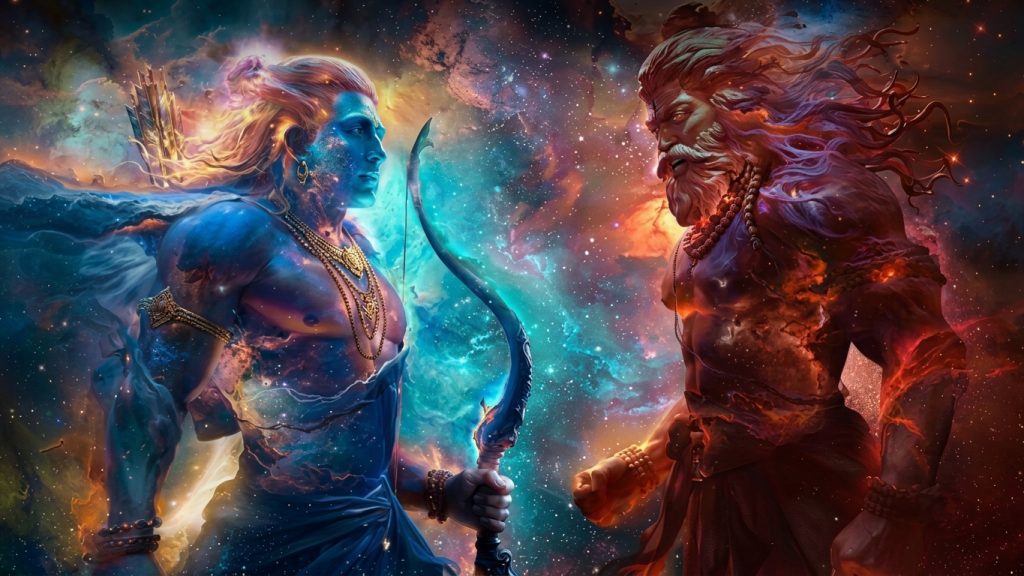
Nitesh Tiwari directed film 'Ramayana' is not a religious film to be watched with devotion. This film is the battle of Ravana's arrogance and Rama's humility. It is a conflict between the untruth adopted by Ravana and the truth that Rama does not abandon.
This is a battle between dignity and arrogance. This is the encounter between the asura nature and the god nature.
One day, out of arrogance and revenge, Ravana abducts Sita.
And they put it in an automatic Pushpak plane and take it to Lanka. At that moment, only one creature, Jatayu, fights to free Sita.
Jatayu is especially a bird.
While wandering in the sky and observing the world, he understands Sita's compulsion. He understands Ravana's deception. That's why Pushpak, flying above the clouds, makes many attempts to free Sita from abduction. They bet their lives.
This is the most tense scene of the film. The intense struggle between the all-powerful Ravana and the ignorant Jatayu does not allow the audience to remain calm.
Sita cannot scream, run, or jump from Pushpak's plane, which is destined for Lanka. This oppressed woman looks down at the ground from that terrible angle, where perhaps Rama and Lakshmana will be looking for her.
It is at this time that Jatayu arrives as a mother to him.
Jatayu places his paw in front of Sita. Ravana sees that Sita is about to be freed from the abduction by holding it. He now starts attacking Jatayu indiscriminately.
There is nothing to fight against the giant Jatayu. However, he tries to push Ravana out of Pushpak Vimana using his strength. In the process, his claws are cut off and his ribs are broken. Finally, Ravana's talisman weapon cuts off his wings.
What can Jatayu do now? Except for shedding tears of defeat from those constrained eyes of his. As a witness to the world, his eyes fill with tears.
While truths were losing and lies were winning, I saw the same tears in Jatayu's eyes that I had seen in the eyes of innocent buffaloes some time ago.
While dragging, dragging, chasing, beating, cutting, immersing those senseless creatures in water, people were writing on Facebook, "Let's openly celebrate the victory of truth over falsehood."
With no one of their own, nothing of their own, they were defeated. They were losing at that moment, while people were cheering the booze saying 'celebration of truth'.
In the end, lies won. Even in the movie and in our world.
Ravana flies Sita to Lanka and the mutilated, bloody Jatayu falls to the ground. Before his death, Jatayu says, 'I'm sorry, I could not help Sita Mata. He was kidnapped by Ravana, the king of Lanka.
He doesn't just say that, how powerful Ravana is, how dangerous his army and workers are, everything is told. They say that it is not only difficult for Rama to reach Lanka, but also impossible.
But, standing on the ground of truth, Rama boldly proclaims, 'Now I will fight. Ravana, your throne of falsehood and arrogance will now fall. Now your body will collapse.
At this time, clouds are gathering in the sky. Wind speed is fast. The echoes of nature are loud.
The first part of the film ends here.
The film ends, but the audience who have been sitting in the same chair for more than three hours do not want to get up. Why did the audience, who were used to watching an average two-hour film, not stay up for such a long time?
Because human hardware is made of truth. They don't want to see lies win. They watched the credits roll on the screen with an insatiable desire for Rama to invade Lanka and defeat Ravana.
'Ramayana' is not a mystery story for Nepali viewers.
Who is Ram? What is Ravana? Nepali viewers can tell their birth chart. 14 years of exile, automatic Pushpaka Vimana, Lanka's bhakan made of gold can be done better than Indra.
But, why did the audience go to the hall to watch the film based on the same legendary book?
Because not only the story of the film, but also the style of telling the story is important. As much as the letters of the mythological texts have been translated into a magnificent and miraculous visual language by modern technology, it has created a special gravity.
However, this is not just a game of VFX. The creation of characters, the combination of events and the subtle messages and visions within it have made it amazing.
The film does not directly show Ravana as an antagonist. Possessed of both consciousness and strength, he becomes a villain after becoming drunk with victories. The film vividly portrays the fierce conflict of human qualities.
When ego, lawlessness and untruth increase in people, how terrible does nature become? Water does not flow in rivers, trees do not grow green, animals do not enjoy themselves.
The film is embellished with a similar message in the inner layer of VFX.
Shiv Mukhia is the Arts and Lifestyle Bureau Coordinator of Onlinekhabar.com. He writes on society, lifestyle and art-entertainment.