India sees Prime Minister Walendra Shah's visit to India as an opportunity to expand ties with the new political leadership. India is also interested in what kind of foreign policy Nepal will adopt under the leadership of Prime Minister Shah, who comes from a different background than the old political parties and leadership.
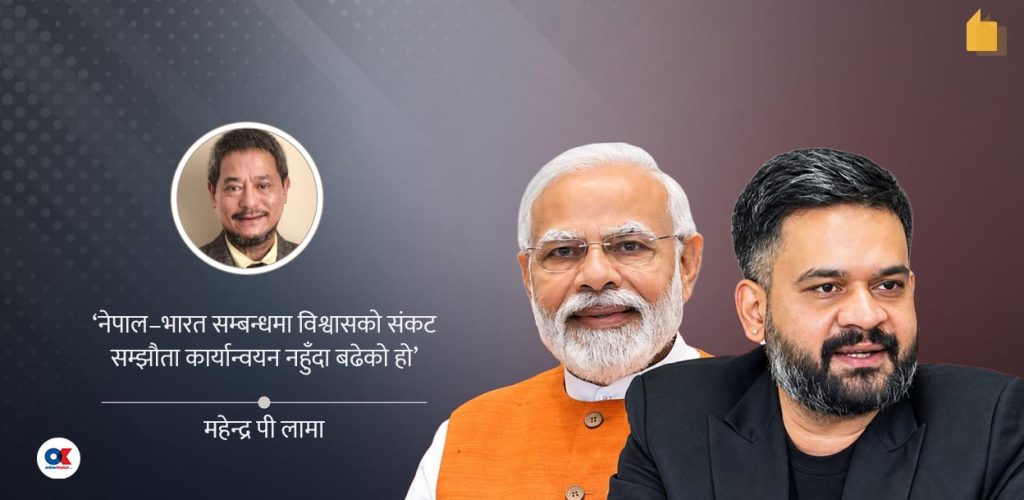
Mahendra P. is an expert on Nepal-India relations and has worked in various government agencies of India. Lama was also a member of the Indian side of the Nepal-India Enlightened Persons Group (EPG). In his opinion, this visit is an important opportunity for both countries. However, to take the relationship to a new height, he said, there should be concrete cooperation on issues such as connectivity, trade, community and climate change, rising above political ups and downs.
According to his analysis, non-implementation of the agreements between Nepal and India is the main reason for the weakening of mutual trust. Here is Durga Khanal's conversation with Lama for online news:
How is Prime Minister Balendra Shah's visit to India viewed from India?
Prime Minister Walendra Shah's visit to India is seen as very important here. Perhaps it is seen with equal importance in Nepal. There are two reasons for this.
First, he comes from a different background than the old political parties and their leadership. He became the Prime Minister from a different political background than the tradition of Nepali Congress, Maoist and Communist Party (including UML).
Second, he has become Prime Minister after a situation created by widespread violent protests. Therefore, what kind of approach Nepal adopts, what will happen next in India is curious.
Has India taken this visit only as an opportunity to get to know the new Prime Minister or is it also looking for a change in its policy with Nepal?
The Prime Minister is the person who represents the nation. It is expected in India that he has come with new ideas, policies and programs.
On the other hand, India is also thinking of having a new type of relationship with its neighboring countries. In the last 10 to 15 years, India's relations with Pakistan, Bangladesh, Sri Lanka and Maldives have not been so good. The Indian government has realized that relations with neighboring countries cannot continue like this, and that strong relations should be built.
In this context, Prime Minister Shah's visit is important. Earlier, SAARC was a forum for all South Asian countries to discuss common issues. Now it is almost dormant. The reasons for SAARC being inactive is a separate matter. However, it lost an important platform for regional dialogue. The situation of bilateral relations is also not good in many respects. Therefore, it is necessary for India to develop relations with its neighbors with a new approach and thinking.
Complaints are heard about political tension in Nepal-India relations and non-implementation of agreed economic issues. Narendra Modi has been in the government of India for 12 years, but during this period, 6 Prime Ministers have changed in Nepal. How do you see this situation?
I understand that the relationship between Nepal and India has been very extensive, deep and of a high level. India does not have such relations with any neighboring country.
Nepal and India have cultural, economic, political and strategic relations. Even when the prime minister changes or there is a political tension between the two countries, it does not have much effect on the relationship. With open borders, people-to-people relations continue whether governments like it or not.
Governments come and go. The government will direct the relationship, move forward with new issues. But that doesn't mean political instability doesn't have an impact. Therefore, both the countries have to work hard to keep the relationship between Nepal and India away from political instability.
Stopping each other on small issues, stopping the import of tea, ginger or cardamom, imposing taxes at the border will not benefit the nation, nor the common people, nor the bilateral relations. Now, instead of getting bogged down in small matters, we should do big things.
There are four topics that I have been talking about. First, connectivity. Second, business. Third, the relationship between communities. Fourth, climate change. Both governments should sit down and make big and long-term plans on these four issues.
What can be done in the field of connectivity and business?
Connectivity has many possibilities. Nepal has been doing business through Indian ports for decades. Similarly, under the Asian Highway, the route from Kakadvitta to Bangladesh through India can be used. Nepal can benefit from the route to Bangladesh's Banglabandha through India's Phulbari Corridor. If Bangladesh gets to use the Matarbari Port being built by Japan, another big business opportunity will open up for Nepal.
There is no reason for electricity trade to be limited only between Nepal and India. Nepal's electricity can be delivered to Myanmar through the northeastern region of India. There is also demand for electricity in Cambodia and Sri Lanka. Such possibilities should be looked at regionally.
Electricity trade connects many people and regions. Farming, hospitals, education and technology are all connected to electricity. Therefore, power trading also makes governments realize that there is a loss when the relationship is unstable. There are examples of similar interdependence in various regions of Europe, America and South Africa. We don't have that kind of relationship.
Sometimes we cut the wires, sometimes we stop the electricity connection. This kind of thinking does not make a relationship mature. The relationship between Nepal and India should be matured.
Small obstacles in trade should also be removed. There should not be a situation where India does not allow Nepal's ginger to come, and Nepal cannot send tea leaves. What difference does it make to India if quality tea from Nepal comes to India? Stopping business based on pressure from some producers is not fair.
Similarly, India accuses Nepal of hoarding goods it does not produce by increasing customs duties. Instead of getting entangled in such small disputes, a bigger solution should be found. A customs union between Nepal and India can be discussed. If the customs system of both countries can be integrated, many of the current problems can be solved.
How do you see the report of the Nepal-India Enlightened Person Group (EPG) on a topic that has not been understood for a long time? Can the new government do anything about border disputes and treaty review?
I don't know what the new government in Nepal and the Indian government think about the EPG report. The EPG report was prepared by representatives of both parties after two years of hard work. It has been widely discussed and studied. The report has been prepared with a long-term perspective. I was in that group too, so I know how much work went into it.
Secondly, it is a committee formed by the governments of both countries. The committee was formed after talks between the Prime Ministers of the two countries. It is difficult to understand the report prepared by it. The government should understand the report. It is the government's right to decide not to accept or implement the suggestions. However, it is not appropriate not to take the report.
I have sat on various government and other committees. However, I have never been in a situation where I could not understand the report of the committee formed by the government. So I myself feel uncomfortable about this matter.
However, I don't know what the Nepali government is thinking, what the Indian government is thinking, what the prime minister and diplomatic officials are thinking about this.
How to assess the possibility of a youth movement in India like in Nepal?
A situation like that seen in Nepal or Bangladesh can never happen in India. India's federal system is very strong. Federal system has just started in Nepal, there is no federal system in Bangladesh. India's federal structure and constitutional arrangements are different.
Therefore, it is a fantasy that a country-wide movement will change the government like in Nepal or Bangladesh. Prime Minister Narendra Modi's government is strong in India. Bharatiya Janata Party is in government in many states.
However, a strong government should consider what neighboring countries can take and what they can give. Above all, a relationship should not be based on one-sided dependence. Look at the relationship between America and India, look at the relationship between China and America. Dependence on each other alone does not make a relationship work.
Strong relationships require mutual dependence. The relationship should progress based on what we can give and what the other party can give. Only relationships that benefit both parties are sustainable. We have seen in South Asia that unilateral dependence does not strengthen relations.
Hindu politics is becoming dominant in India. There is concern that its impact may also be felt in Nepal. How do you see it?
Nepal is an independent country with its own sovereignty. It is Nepal's weakness to worry only about the influence of other countries and what other countries say. Failure to protect the sovereignty and independence of one's country is a weakness of leaders, political parties and the entire political system.
Look at Bhutan. Despite being a small nation, it has maintained its position on various issues. Let's look at the issue of refugees from Bhutan. We have done a lot of analysis on how they exited, why they exited, and why they exited. However, what stance did Bhutan take on the matter of taking the refugees back? He did not take back a single refugee.
This shows that even if the size of the nation is small, it can be strong in its position. Nepal's leaders and political parties should also think about the country's stance. One should not worry only that such and such influence will come from another country.
After the Prime Minister's visit to India, how much can the mistrust in Nepal-India relations be removed?
This visit is also an opportunity to build trust. There have been many incidents between the two countries that have damaged each other's trust and relations. They have also happened from Nepal, they have also happened from India. Now there is a lack of trust between Nepal and India, it needs to be strengthened.
The relationship also had its ups and downs in the 1970s and 1980s. However, trust was then rebuilt. It can be done even now.
I think one of the main reasons for the weakening of trust in Nepal-India relations is the non-implementation of agreements between the two countries. Many agreements have been signed. Some have been stopped in the middle, some have not been implemented at all, some have just started.
After signing the contract, who will monitor its implementation? After Nepal and India reach an agreement on electricity or cross-border climate cooperation, it should be clear how it will be implemented and who will monitor it.
I think there should be regular and effective monitoring at the level of the Prime Minister or at the level of the Foreign Minister and high government officials. Unless there is high-level monitoring, similar lapses in contract implementation will continue.
Mahakali, Pancheswar and railway agreements have been signed. They have not been able to move forward. Someone should monitor why they didn't move on. There are joint commissions, but they have their own government process to work. There are meetings, discussions, disputes, then a year or two passes.
This should not be the case anymore. Now access to internet and communication has increased. Citizens are very knowledgeable. They raise questions if the agreement made by the government is not implemented.
Therefore, the government should be very careful and monitor the implementation of the agreement in an institutional and high-level manner.
Is there a need for cooperation between Nepal and India in matters like the recent accidents in Bhotekoshi and Rasuwa?
The accidents at Bhotekoshi and Rasuwa have shown the need for cross-border cooperation. What Nepal and India can do to reduce the damage caused by such disasters and accidents should be discussed during the Prime Minister's visit.
It requires cooperation at the scientific, institutional, political and community levels. From sharing technology and data to sharing knowledge and experience, a clear outline should be made.
Nepal and India should also establish an institutional network regarding relations with China and dialogue with the Chinese side. Discussions are needed on how to share data and knowledge. The Prime Minister has raised this issue at the United Nations, but a mechanism is needed to move it forward. Nepal alone cannot do everything.
Countries like Nepal, India, China, Bangladesh and Bhutan should raise a common voice in the international conference on climate change. This requires regional cooperation.
So I think SAARC should be reactivated. SAARC had already done a lot of work. At the regional level, leaders of seven or eight countries sat and discussed common issues. Now that organization has weakened.
Bilateral relations have not progressed as expected. Nepal's impact on the international forum alone may be limited. There is a need for regional countries to stand together and raise their voices on common issues.