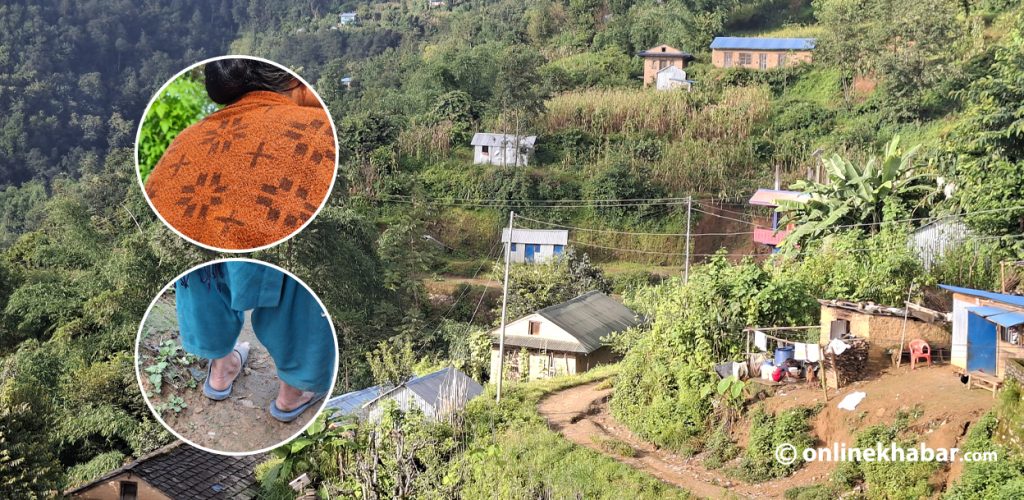
5 October, Dang. Three years ago, 45-year-old Geet from Dang heard the news that the Lumbini state government was providing free treatment to the conflict victims. Having suffered in the conflict, he felt that the government will do something even if it is late.
As soon as she went to the district administration to get the recommendation that she was a victim, the staff asked for the authority of being a victim of conflict. Then she was shocked. Because he did not have the identity card of the victim, nor the name in the list of victims. Unable to prove that she was a victim, she returned home disappointed.
The story of Geeta's war, which was not included in the list of victims, is terrifying. There are witnesses in the heart, wounds and injuries that will never be forgotten.
The incident is around 059. The husband, who participated in the Maoist war, was underground. She used to be alone at home. The police, who were looking for her husband, forced her. She was 17 days pregnant when she was raped.
She lived by hiding the incident for a long time when she was subjected to violence. She was raped while giving birth and had a scar on her uterus.
"For many years I did not tell anyone what happened to me," she said, "My husband would understand, one day I could tell him."
With the help of her husband, she gradually gathered courage. And she was able to speak about the injustice done to her.
After nearly 10 years of the peace process, she gave her name to the then peace committee. She reached all the places through the municipality, district administration to the ward office asking for relief.
Like other victims, he was expected to get justice and relief.
Time passed. But she neither got justice nor relief. Only a year passed by.
As a war victim, I went to many places to seek justice. I asked for uterine treatment, she said, "In return, I got only insults."
He thinks that there will be no justice for war victims. She says, 'I have spent so many years in hope. Now I don't know where to ask for justice.
Harimaya from East Rukum was also a victim of sexual violence during the Maoist war. She was raped by three policemen in the year 061 when there was a forest to graze goats. At that time she was 17 years old.
I told someone about that incident. It was not even in the situation. It took me a long time to understand that I am a victim of conflict,' she said, 'When I understood, it was getting late to ask for justice.'
It was only in the 70s that she applied to the Truth and Reconciliation Commission saying that she was a victim of sexual violence. Like other victims, she also waited for relief and justice.
The first few years passed like this. Because the state at that time gave relief to the dead, missing, injured and disabled in different stages in installments. The government was also announcing the giving of living allowance to the conflict victims.
But time passed. Powers changed time and time again. But like Geeta, there is no change in his life.
In this anger, she reached the district administration. The administration staff suggested going to the Kathmandu Truth and Reconciliation Commission. It's not just an impulse, she went to the commission and complained to the staff in the pain of living with injustice for years, 'Why didn't they give us relief?'
"I had a fight about giving it to someone and not giving it to someone," she said. And I ended up crying.' After that she never went to ask for justice again.
While from his own village, the wounded and disabled people were getting relief and treatment from time to time.
"It hurts me to remember the discrimination done by the state rather than not giving relief," she said.
Rather than the delay in delivering justice, it is painful to remember the state's discriminatory treatment of victims of sexual violence. His only question is, 'After suffering in the war, why are we not called victims?'
20 years have passed since peace was established in the country after a 10-year ceasefire. On November 5, 2006, when the then rebel Maoists came to the peace process, 12 points were agreed upon. One of the important points of the agreement was to provide justice and relief and redress to the victims by finalizing transitional justice.
About a decade after the peace process, the Investigation, Truth and Reconciliation Commission Act, 2071 was issued to complete the transitional justice. After that, the work of finalizing the transitional justice proceeded.
By the 1980s, three commissions were formed. In the meantime, taking complaints of victims, identifying victims, providing interim relief and treatment were done. 1 million was given as interim relief to the families of the dead and victims, while final relief and subsistence allowance were given to the injured, disabled and victims of torture.
Although the work of finalizing the transitional justice did not progress, they felt relieved by the work of providing interim relief and subsistence allowance to other victims. But in this process, the victims of sexual violence during the conflict were not included.
According to Maina Karki, the former parliamentarian and president of the conflict-affected Sazh Chautari, victims of heinous crimes such as sexual violence were neglected in those times.
"They were not considered official victims of the war," she said, "so the victims of sexual violence were exempted from the interim relief and justice process." This is a big mistake by the state.
Man Dhakal, a former member of the Truth and Reconciliation Commission, says that despite recommendations for compensation in some cases of sexual violence, the victims have not received relief.
At that time, we sent the commission to the Ministry of Finance for interim relief to the victims of some incidents, she said, but it could not be implemented.
Lumbini is the most conflict-affected province. In Lumbini, most victims are from Rolpa. According to the then local peace committee, there are 946 dead, 33 missing and 505 injured and disabled in Rolpa alone. About 200 complaints have been filed in the Commission on sexual violence alone.
But for the victims of sexual violence, no relief work has been done so far. Dinesh Subedi, a journalist working in the field of conflict-era sexual violence victims, says that not only the union government, but also the state and local governments have neglected the victims. He says that more than 200 victims from Rolpa have openly submitted their applications.
"Most of the victims of sexual violence are from Rolpa," he said. But there is nothing like that in the case of victims of sexual violence. While in Rolpa, some of the war wounded and disabled people are still getting living allowance.
For example, one can look at the Lumbini state government. The provincial government has been providing free treatment up to 50,000 annually for the injured during the conflict. According to Suresh Chandra Acharya, Deputy Secretary of the Ministry of Internal Affairs, Law, Industry and Transport, for the past few years, the injured during the conflict have been receiving free treatment in the Ministry of Internal Affairs of the District Administration and Provincial Ministry. While there is discrimination in the health treatment of victims of sexual violence.
He said that the victims who have been living with injustice for years are suffering from mental and reproductive health problems. According to him, the victims are living in a very miserable condition financially. Wounds of the uterus remain unhealed. He says that the most relief and counseling is for victims of sexual violence.
"Sexual violence victims have neither justice nor relief," he said, "this has added more pain to them."
One of the victims says, 'There is no state for us. If it was, he would have seen our wounds. I could hear the pain. He would behave like a victim.
Budhathoki is a correspondent of Online Khabar.